What is bingo? The history, the rules and the famous calls
Bingo is one of the world's best-loved numbers games: simple enough to learn in one round, sociable enough to fill halls, holiday camps and front rooms for a century. Here is what bingo actually is, where it came from, and how to host a bingo night of your own, free, with an online bingo caller.
What is bingo?
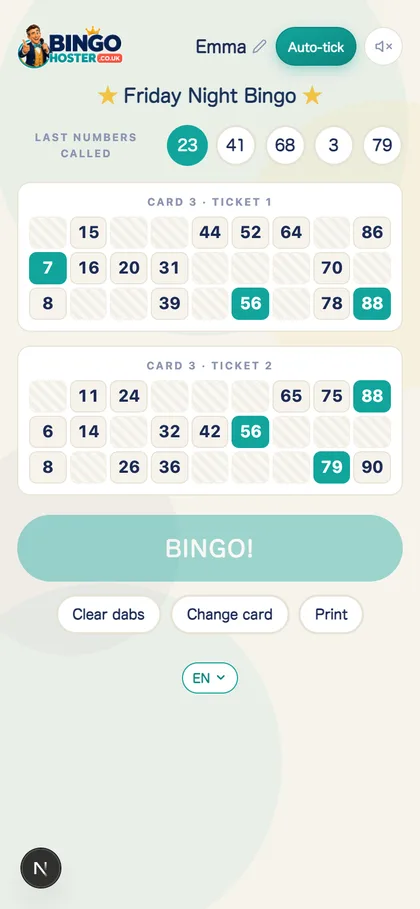
Bingo is a game of listening and luck. Every player holds a bingo ticket (also called a bingo card) printed with a selection of numbers. A bingo caller announces numbers one at a time in random order, and players dab off any number that appears on their ticket. Complete the winning pattern first, one line, two lines, or the whole ticket, and you shout BINGO! at the top of your voice. That's the entire game, and that's exactly why it works for every age from small children to great-grandparents.
In the UK the standard game is 90-ball bingo. Each ticket has 3 rows and 9 columns with 5 numbers on every row, 15 numbers in all. Prizes typically go to the first single line, the first two lines, and the first full house, when every number on the ticket has been called. In North America the common game is 75-ball bingo, played on a five-by-five card with lettered B-I-N-G-O columns and a free centre square; the caller announces both letter and number, B12, G48. BingoHoster plays both types, in every mode.
A short history of bingo
Bingo's family tree goes back nearly five hundred years. It begins in 1530s Italy with a national lottery game called Il Gioco del Lotto d'Italia, a draw that is still running today. The game crossed to France in the 1770s as Le Lotto, a parlour game for the well-to-do that introduced the familiar tokens, calling and playing cards divided into rows and columns.
By the 1800s, Germany was using lotto-style games in classrooms to teach children multiplication tables and spelling. The modern game arrived in 1929 America as a carnival stall game called Beano, players covered their numbers with dried beans. New York toy salesman Edwin S. Lowe watched a winner get so excited she shouted "Bingo!" instead of "Beano!", and the name stuck. Lowe hired a maths professor, Carl Leffler, to devise thousands of unique cards, and bingo swept the country.
Britain made bingo its own from the 1960s, when changes in the law let bingo halls open across the country. Converted cinemas and dance halls filled with players every night of the week, the callers' nicknames for the numbers became part of the national vocabulary, and bingo settled into seaside piers, holiday camps, church halls and working men's clubs. Today the same game is just as likely to be played at a family party, a school fundraiser or a care home social, with the caller running on a laptop instead of a stage.
The famous bingo calls
Bingo's traditional calls are half the fun: rhymes and jokes for the numbers, polished by decades of callers. BingoHoster's voice caller uses the classics. A few favourites:
- 1 Kelly's eye
- 7 Lucky seven
- 8 Garden gate
- 9 Doctor's orders
- 11 Legs eleven
- 13 Unlucky for some
- 21 Key of the door
- 22 Two little ducks
- 30 Dirty Gertie
- 39 Steps
- 44 Droopy drawers
- 45 Halfway there
- 50 It's a bullseye
- 55 All the fives
- 57 Heinz varieties
- 59 The Brighton line
- 66 Clickety click
- 76 Trombones
- 80 Gandhi's breakfast
- 88 Wobbly wobbly
- 90 Top of the shop
Numbers without a nickname are called the traditional way, digits first: "seven and three, seventy-three", so everyone hears it clearly across a noisy room.
How to host a bingo night at home
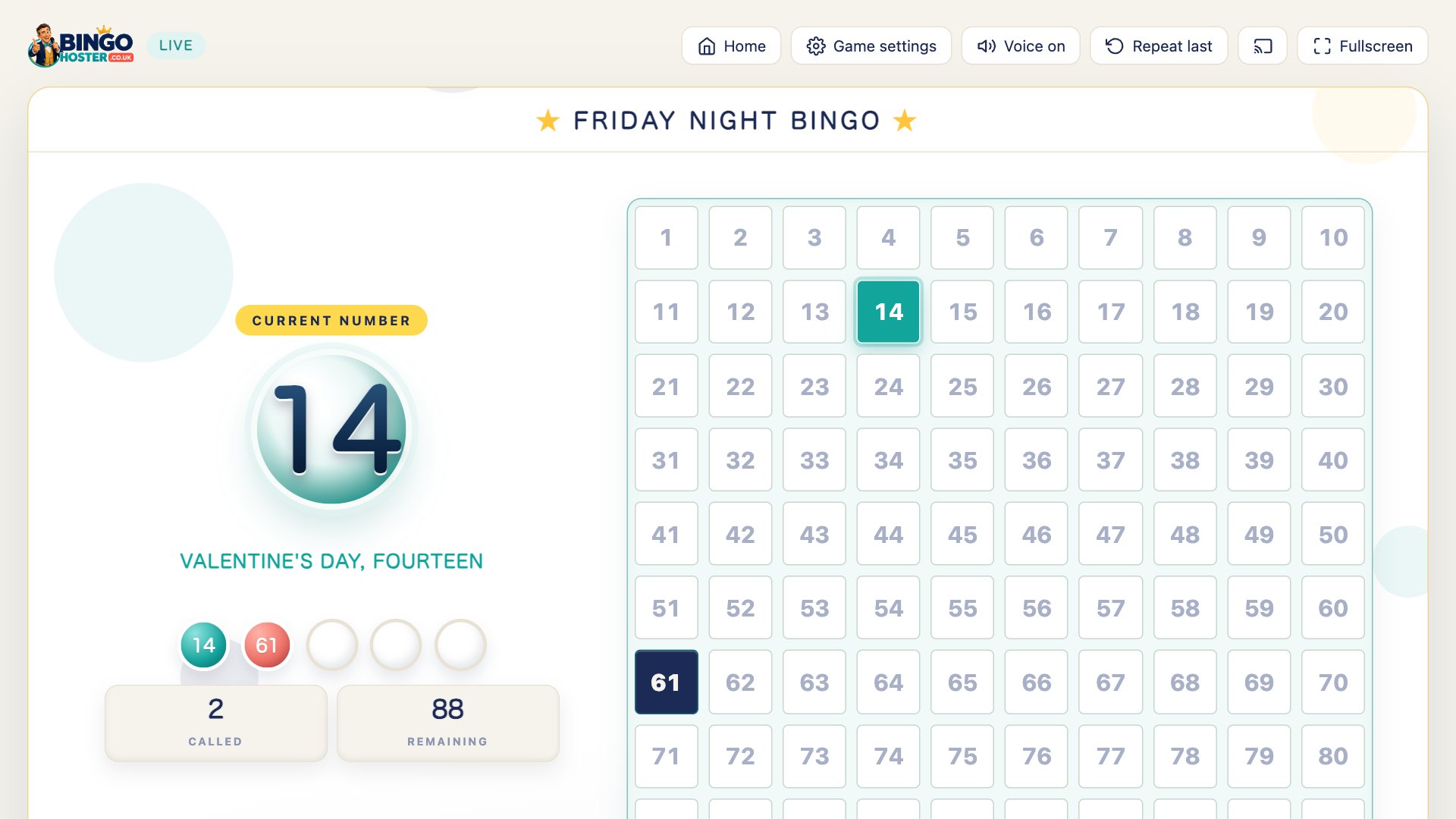
Running a bingo night used to mean a cage of balls and a strong voice. Now a free online bingo caller does the work: it draws the numbers randomly, announces them aloud with proper bingo calls, shows the big number board, and checks the wins. BingoHoster was built for exactly this:
- The Hoster: a full bingo caller and number board for the big screen, 90-ball or 75-ball. Hand out paper tickets, cast the game to your TV, and press play. Space bar pauses the calls; press B when somebody shouts bingo and every screen celebrates.
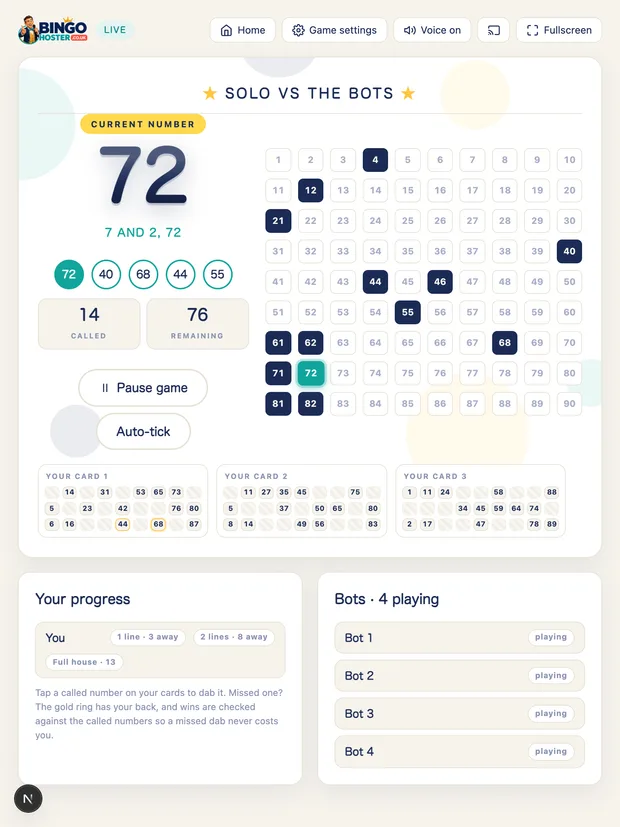
- Solo: play bingo online by yourself against computer players, with up to nine auto-dabbing cards.
- Themes, voices and pace: pick a caller voice and speed, and dress the whole game for Christmas, Halloween, Easter, summer, birthdays or outer space.
It is completely free, with no sign-up and no payments, and it never sells tickets, you bring your own books and dabbers, exactly like a village hall night. That makes it a natural fit for family game nights, birthday parties, care homes, schools, charity fundraisers and community events. For the full tour of the caller itself, see the free bingo caller; for game-night ideas, including bingo over a video call, see how to play bingo with friends.
Questions people ask
What is bingo in simple terms?
Bingo is a numbers game. Every player has a ticket printed with a selection of numbers, a caller announces numbers one at a time in random order, and players mark off any that appear on their ticket. The first player to complete a line, two lines or the whole ticket (a full house) shouts BINGO! and wins.
How do you play 90-ball bingo?
A 90-ball bingo ticket has 3 rows and 9 columns, with 5 numbers on each row (15 numbers per ticket). The caller draws numbers from 1 to 90. Prizes usually go to the first single line, the first two lines, and the first full house, when every number on the ticket has been called.
Is BingoHoster really free?
Yes. BingoHoster is a completely free online bingo caller. There is no sign-up, no payment, and no digital ticket selling. You bring your own paper tickets and players; the site calls the numbers, shows the board and celebrates the wins.
Can I put the bingo caller on my TV?
Yes. You can cast the game to a TV with one tap in Chrome, use AirPlay screen mirroring on Apple devices, or simply plug a laptop into a TV or projector and press Fullscreen. The number board, countdown and BINGO celebrations all show on the big screen.
What do the famous bingo calls mean?
Bingo calls are traditional nicknames for the numbers, born in British dance halls and seaside towns. Legs Eleven is 11 because the digits look like a pair of legs; Two Little Ducks is 22 because the 2s look like swimming ducks; Wobbly Wobbly is 88 because two eights wobble like jelly.
Eyes down in under two minutes. No sign-up, ever.